

What to Expect on a Walking Safari in Zambia
A walking safari in Zambia transforms how visitors relate to the natural world. Many people who go on safari say a game drive changed the way they see wildlife. Those who've walked the bush tend to describe something different, they say the experience changed the way they see themselves.
On a guided bush walk in Zambia, the landscape stops being a backdrop and becomes something you're moving through. South Luangwa National Park is where this experience was born. Norman Carr led the first walking safaris here in the 1950s, and the valley has remained one of Africa's most established and respected regions for walking safaris ever since. At Chimbwete Trails, we've built our walking programs around direct, on-the-ground relationships with guides who know individual animal ranges and seasonal movements in this specific valley.
This guide covers what the experience actually feels and sounds like, what wildlife encounters look like at ground level, how safety is managed, and how to prepare and budget for a walk in the Luangwa Valley. No hype, no glossing over the hard parts. Just what you're actually signing up for.
The sensory shift: what changes when you leave the vehicle
A game drive and a walking safari are not the same experience delivered by different vehicles. They are fundamentally different relationships with the same landscape. The vehicle filters out nearly everything that makes the bush feel real: its noise muffles the soundscape, its height creates a psychological distance from the ground, and its frame keeps you in the role of observer. On foot, that buffer disappears entirely.
Wind direction starts to matter. Your footfall matters. So does the way you hold your body. These are things that never cross your mind from a Land Cruiser seat, and they consume your attention from the first step out of camp.
Within the first hour of walking, many guests report a sensory recalibration that's hard to predict until you experience it. The smell of dry grass and elephant dung becomes specific and real rather than atmospheric. The texture of cracked clay underfoot tells you something. You may hear a buffalo breathing before you see it, a reminder of just how close the bush actually is. These aren't details you notice on a game drive because a game drive doesn't ask you to. Walking the Zambia wilderness trails of the Luangwa Valley asks you to notice everything, and most guests find that shift is the most memorable part of the entire trip.
What wildlife encounters actually look like on foot
Encounters on a South Luangwa walking safari are not a scaled-down version of game-drive sightings. They're a different category of experience. When you're on foot, you're approaching an animal at its own level, in its own space, and both you and your guide are reading cues that a vehicle never demands of you.
Reading animal behavior at close range
Professional walking guides interpret a constant stream of information: ear position on an elephant, a buffalo's angle of attention, the particular silence that means something shifted nearby. Guests learn to read some of these cues quickly because they have to. That active engagement is part of what makes the experience so absorbing. You're not watching wildlife; you're sharing a space with it.
Elephants, buffalo, and hippos behave differently when encountered at ground level. They're more aware of you, and you're more aware of them. That mutual awareness is the draw, not a side effect.
Species you're most likely to encounter in the Luangwa Valley
South Luangwa delivers some of Africa's strongest leopard sightings, along with lion, buffalo, elephant, and large hippo populations concentrated along the river. The valley is also home to three endemic species found nowhere else on earth: Thornicroft's giraffe, Cookson's wildebeest, and Crawshay's zebra. Encountering a Thornicroft's giraffe on foot, at a distance measured in meters rather than windscreen-lengths, is the kind of thing that doesn't translate in a photograph.
Birdlife is exceptional throughout the year, with over 450 recorded species including African Skimmers and Southern Carmine Bee-eaters. Crocodiles and hippos are frequently encountered near oxbow lagoons and river channels, and both require careful positioning from your guide. The specific animals you encounter, and how close those encounters unfold, depends significantly on season and the areas your guide chooses to walk.
How safety is managed on a walking safari in Zambia
The question most first-timers are afraid to ask directly is: is this dangerous? The honest answer is yes, risk exists in the Luangwa Valley. A professionally run walking safari manages that risk through strict protocol, experienced guides, and a clear chain of command. The safety system is more robust than most people expect before their first walk.
Your guide's role and the rules of the trail
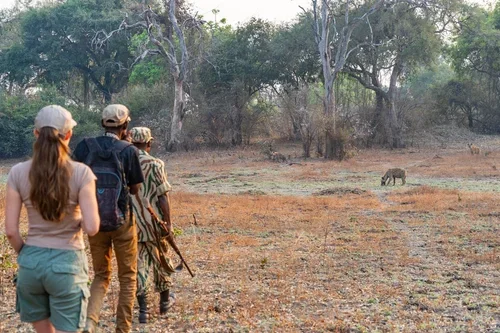
The lead guide sets the pace, determines the route, and makes all decisions about animal contact. Guests walk in single file behind the guide, stay silent when instructed, and do not break formation unless the guide directs otherwise for safety reasons. Hand signals replace spoken commands when you're close to animals. These rules are explained before you leave camp, and they're non-negotiable.
In Zambia, walking safaris in dangerous-game areas operate with an armed guide qualified as an advanced trails guide, a designation that requires firearm competency, logged field hours, and assessed walking experience. This is a separate qualification from general safari guiding, and it takes years to earn. A wildlife scout often accompanies the group as a second line of safety. The rifle is a last resort; the guide's primary tools are animal behavior expertise and prevention.
What separates a professionally run walk from a risky one
Guide qualifications matter more on a walking safari than in almost any other context in travel. Ask specifically how many years your guide has spent walking South Luangwa, not just guiding in Africa generally. Intimate knowledge of specific animal ranges, seasonal movement patterns, and terrain-level behavior in the Luangwa Valley is not transferable from other parks. At Chimbwete Trails, our walking programs are built around guides with verified, multi-year experience walking this specific valley, because that ground-level familiarity shapes every decision made from the moment you leave camp.
Getting ready for a walking safari in Zambia: fitness, health, and packing
Most walking safaris in South Luangwa require moderate fitness, not athletic conditioning. A typical day involves two to five hours of walking at a relaxed pace over uneven ground, covering roughly three to ten kilometers depending on the itinerary. The honest benchmark: if you can walk briskly for two to three hours without stopping, you are ready. A mobile walking safari in Zambia, where camp-to-camp moves are part of the itinerary, may cover closer to ten kilometers per day and ask a bit more of you, but the pace is always set with the group in mind.
Malaria prophylaxis is essential for any trip to Zambia. Consult a travel clinic well before departure, as starting some medications requires lead time. Yellow fever vaccination may be required depending on your transit routing. Anyone with heart, joint, or respiratory conditions should get medical clearance before booking a multi-day walk.
The packing list that actually matters
Neutral colors are non-negotiable: khaki, olive, beige, and brown. Bright colors and strong perfumes can alter animal behavior and should be left at home. Beyond that, the essentials are straightforward:
Lightweight, breathable long-sleeved shirts and trousers for sun and insect protection
Ankle-supporting walking boots broken in well before travel (not brand new from the box)
A wide-brim hat and high-SPF sunscreen
Strong insect repellent and personal medications including malaria prophylaxis
Binoculars, a small daypack, and a reusable water bottle
A light fleece or sweater for cool mornings and evenings
Leave noisy accessories, jewelry, and anything that reflects light or creates unnecessary sound at home. A basic first-aid kit with blister pads and antihistamines is worth adding. If you photograph wildlife, bring extra batteries and memory cards. Dust is constant in the dry season, and a waterproof pouch for your camera gear is a practical investment.
When to go and what a walking safari in Zambia costs
The sweet spot for a walking safari in the Luangwa Valley is July through October. Late dry season, August through October, delivers thinner vegetation, wildlife concentrated around shrinking water sources, and dry, walkable trails. July and August offer cooler mornings, which makes longer walks more comfortable. October brings heat but often extraordinary game density near the last water of the dry season. The green season, November through April, makes walking impractical in most areas: tall grass limits visibility significantly, trails become muddy, and many bush camps reduce operations or close for the season entirely.
Walking safari packages in South Luangwa run roughly $600 to $1,200 per person per night and are generally sold as all-inclusive (prices vary by camp category and season). Accommodation, all meals, guided walks, park fees, and ground transfers are typically covered. International flights, visas, tips, and optional add-on activities are usually excluded. A five-day trip typically lands between $3,000 and $6,000 per person. That range reflects the real difference between a small remote bushcamp and a larger lodge. Smaller, more remote bushcamps generally offer a more walking-focused experience and more direct access to prime wildlife areas.
Why your choice of operator defines the whole experience
A booking platform can put you in South Luangwa. It cannot tell you which areas the leopards have been using this week, which camps are positioned best for morning walks in October, or which guide has spent fifteen years learning the animals on the Chikoko Loop. That level of local knowledge only comes from being physically present in the valley, continuously.
What a locally based specialist brings to a bush walk
Generic international operators manage logistics from offices far removed from the park. Chimbwete Trails operates on the ground in South Luangwa, with direct relationships with eco-certified bush camps and guides who know individual animal territories. That means your itinerary is built around current conditions, not last season's reports. Which areas to walk, which camps to use, how to position guests for the best encounters, these decisions change week to week. They require someone who is actually there.
Questions to ask before you book a Zambia foot safari tour
Before committing to any operator, ask how many years your specific guide has walked South Luangwa, not Africa generally. Ask about group size limits on foot, because smaller groups consistently produce better encounters. Ask what the protocol is for a close buffalo or elephant encounter, and listen to how specifically they answer. Ask whether the operator holds recognized certifications and whether their partner camps are eco-certified or Fair Trade Tourism accredited.
That kind of specificity is worth waiting for. Chimbwete Trails offers consultations built on firsthand, current local knowledge, reach out if you want to know what's actually happening in the valley right now, not what the brochure says.
The walk is the point
A walking safari in Zambia is not a variation of a game drive. It is a different experience at a sensory and psychological level, one that asks more of you and gives back something genuinely hard to describe to someone who hasn't done it. The preparation matters, the timing matters, and the guide matters more than anything else.
South Luangwa is the region to prioritize. July through October is the window that delivers. Moderate fitness is enough. And the operator you choose shapes every element of what happens from the moment you step out of camp.
If you're ready to stop watching the bush through a windscreen and start walking through it, the next step is reaching out to someone who is actually there.
