

What Is a Zambian Safari Camp Really Like?
Most people planning their first African safari picture a lodge, a building, maybe, a veranda, a pool, a dining room with a view of the plains. A Zambian safari camp is something else entirely. The difference isn't primarily about budget; it's about what kind of experience you're actually after. While price bands do overlap between camps and lodges across Zambia, the more meaningful distinctions come down to design, scale, and immersion.
After years of walking through camps along the Luangwa River, the question we get most often at Chimbwete Trails isn't which camp to book. It's: what's it actually like? That question deserves a straight answer, because the gap between what people imagine and what they find when they arrive can go either way. Some guests are overwhelmed by the proximity. Others say it's the only way they'd ever travel again. This article explains what you're walking into, honestly.
Camp vs. lodge: what a Zambian safari camp actually offers
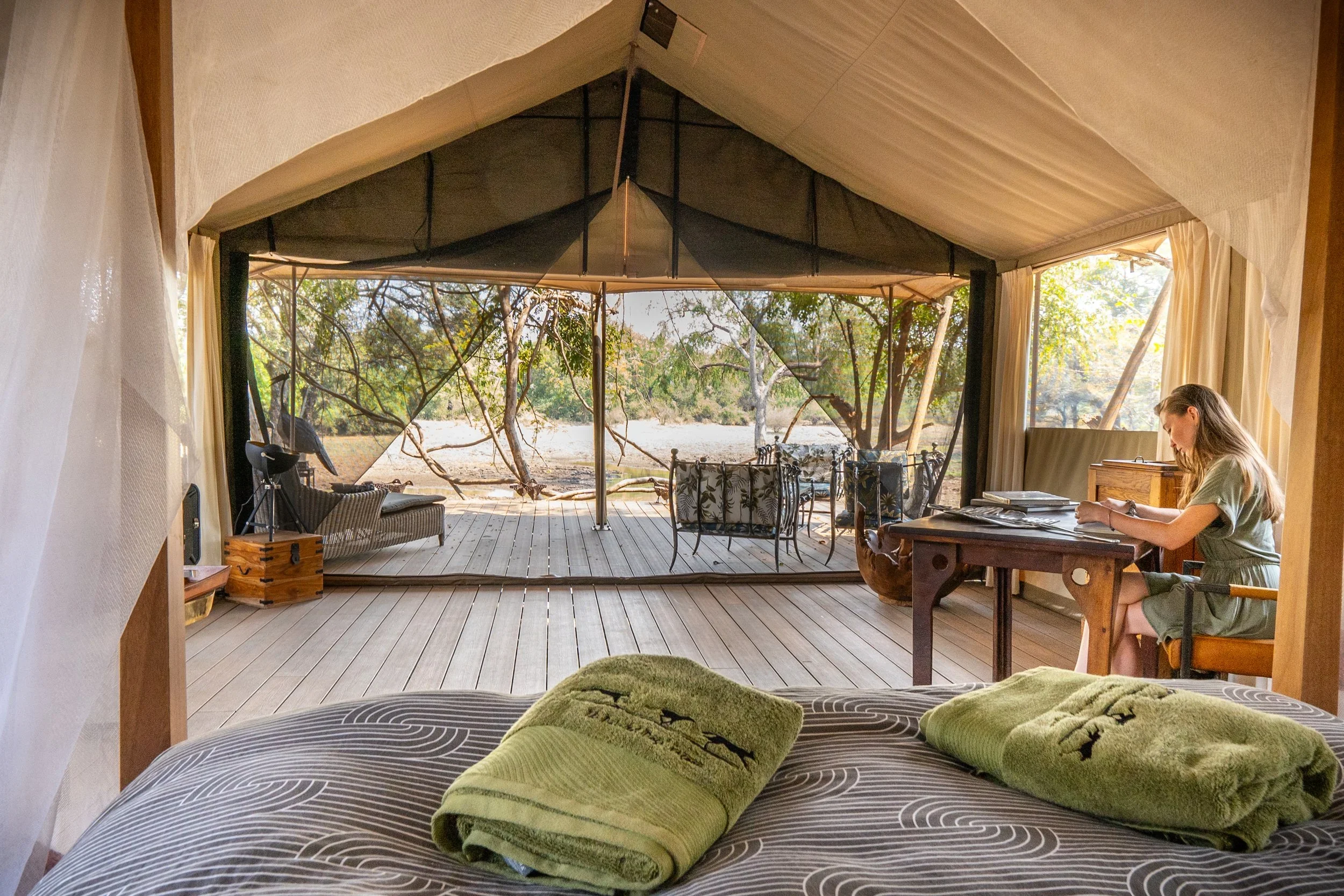
A Zambian safari camp is typically built from canvas, thatch, and timber. The sides are open mesh rather than solid walls and glass. That design isn't rustic by accident, it's intentional. The boundary between inside and outside is meant to blur. Sounds move through the space. Air moves through the space. So does everything else that lives in the bush around you.
Scale is the other major difference between a Zambia safari camp and a conventional lodge. Most South Luangwa camps host between 6 and 16 guests at a time. A lodge might run 40 or more. That gap in numbers changes everything about how a safari operates: private vehicles, flexible schedules, guides who know your name and your priorities within a day or two. When there are only eight guests in camp, you're not competing for a sighting. You're there for it.
The comfort spectrum is wider than most booking platforms suggest. Some camps are genuinely rustic: solar power that dims after dark, bucket showers, basic furnishings. Others along the Luangwa River offer proper ensuite bathrooms, premium bedding, and plunge pools, what most travelers would recognize as luxury safari Zambia operators provide at their best properties. In 2026, the spectrum runs from classic bushcamps at roughly US$500 per person per night to premium tented suites above US$2,000. Both ends are legitimate. They're just different experiences built for different travelers. Knowing which tier matches your threshold before you arrive prevents disappointment that has nothing to do with the wildlife.
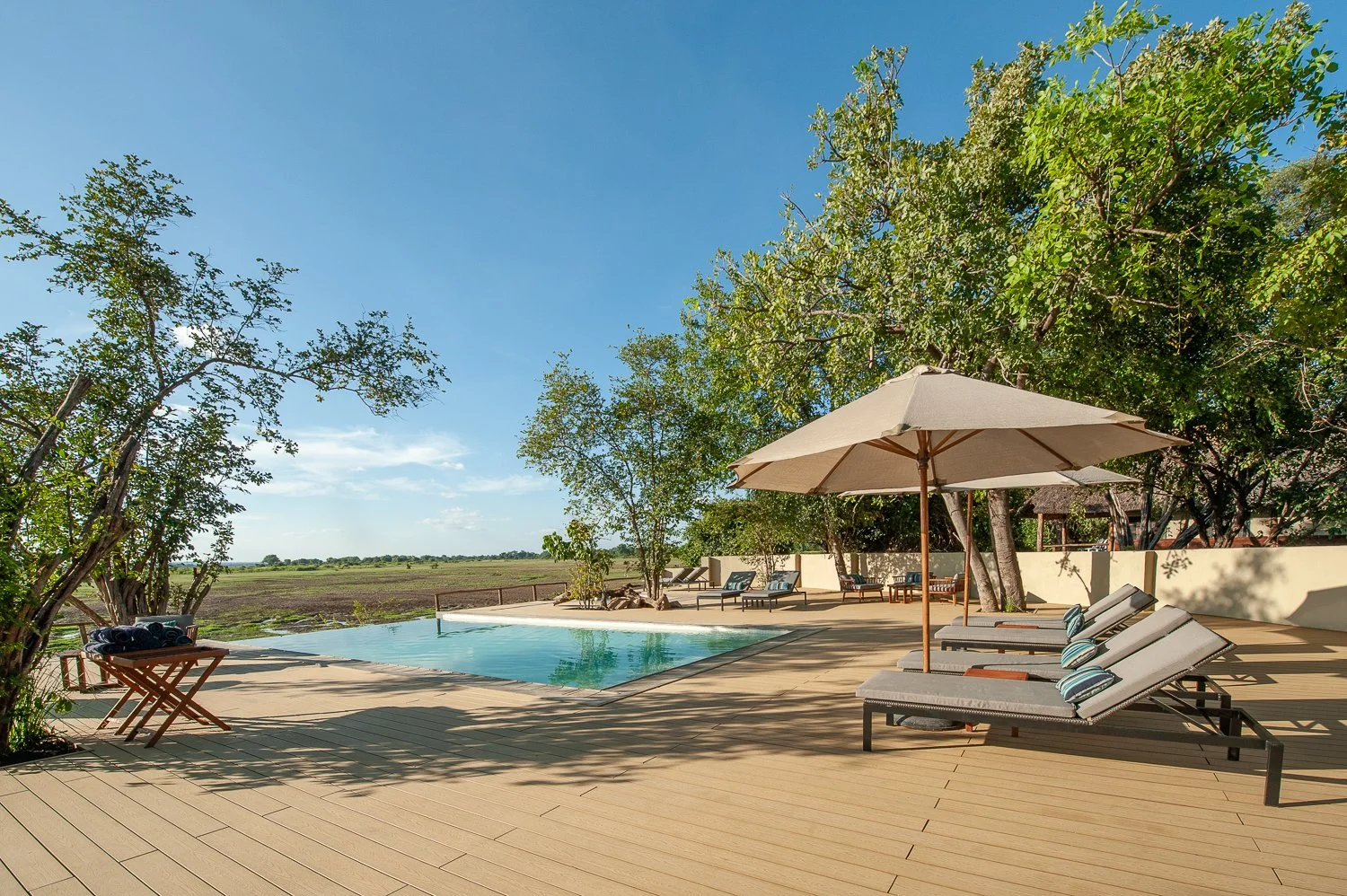
timber deck overlooking the Luangwa River
How close the wildlife actually gets at a Zambia safari camp
South Luangwa camps are positioned directly on or within walking distance of the river. This isn't coincidence. The dry season concentrates animals near permanent water, and a camp built on the riverbank sits inside that concentration zone rather than at its edge. Hippos surface just meters from the dining tent at breakfast, not as the highlight of the trip, but as an ordinary Tuesday morning.
The more significant reality is what happens after dark. Elephants browse through camp. Hippos move between the river and their grazing areas along paths that run through the property. Leopards use camp corridors as part of their nightly circuits. This isn't staged. It's what happens when you build a camp inside the ecosystem rather than beside it. One Chimbwete Trails guest described lying awake listening to an elephant work its way through the trees just outside her tent, saying she'd never felt so awake in her life, a sentiment that comes up in guest accounts more often than you might expect.
Most camps in South Luangwa are unfenced, by design and by philosophy. Fences disrupt wildlife movement and undermine the immersion the camp was built to deliver. At most camps, walking between tents after dark is done with a staff escort carrying a torch, a standard arrangement that prioritizes both safety and the full bush experience. For prepared guests, this isn't a safety concern. It's the price of genuine proximity, and most people who've experienced it say it's worth it.
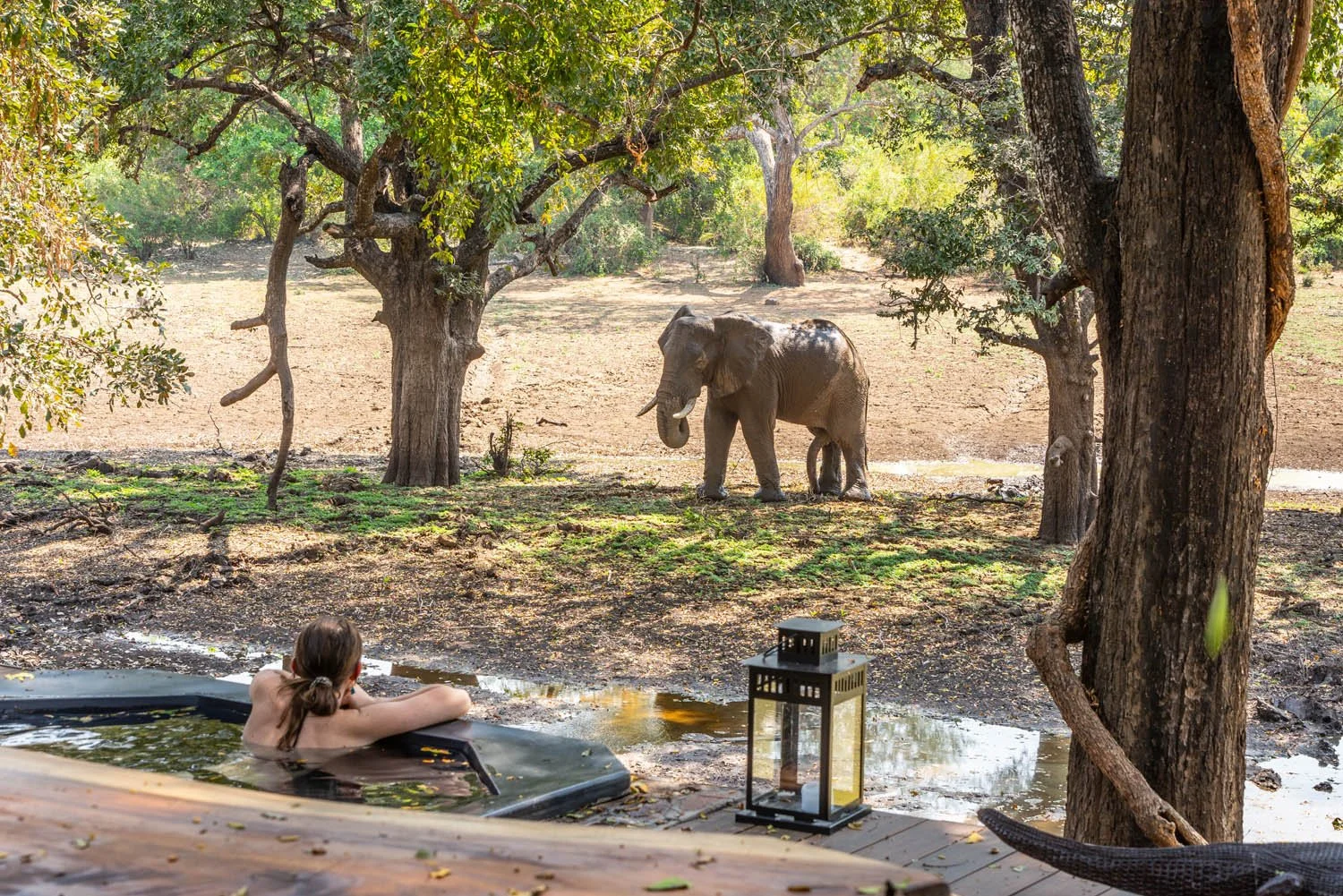
You relax in a private hot-tub while receiving frequent wildlife visits
What a full day at a South Luangwa camp looks like?
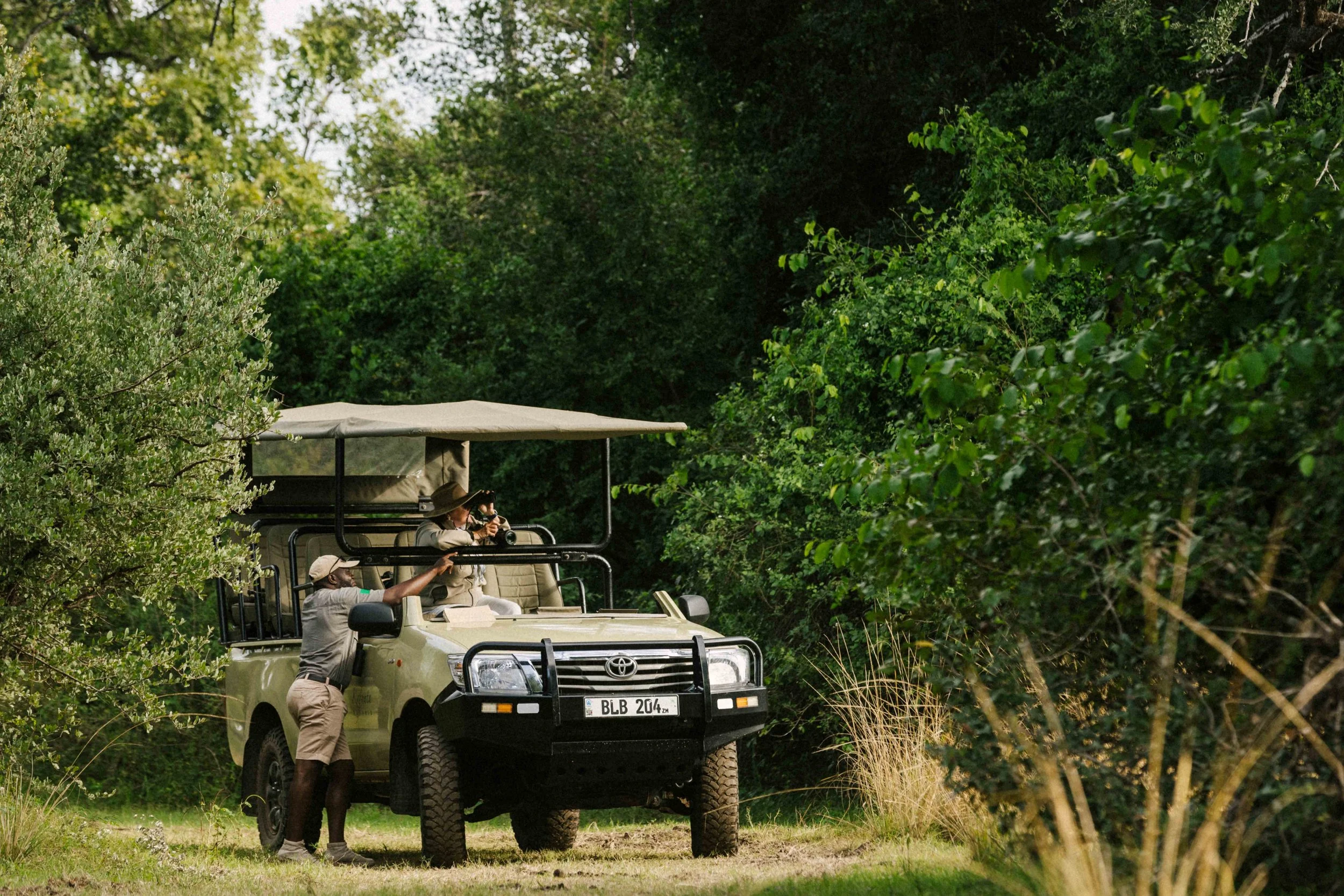
The day starts at around 5:30 a.m. with a hot drink before boarding an open 4x4 vehicle. The morning drive runs three to four hours through the coolest, most active window for predators and browsers. Your guide tracks animals by spoor, reads the terrain, and positions the vehicle for sightings that South Luangwa's exceptional guide-to-guest ratios make possible, a genuine advantage over more crowded parks where access after dark is restricted and vehicle numbers are capped. The guest's job is to watch and ask questions.
Most camps operate a quiet midday period from roughly 11 a.m. to 3 p.m. This mirrors animal behavior: the heat drives wildlife into shade, so there's nothing to see and nowhere comfortable to look for it. Lunch happens under thatch. The afternoon stretches out in ways that feel unfamiliar if you're used to a packed itinerary. Birds, insects, the distant grunt of something on the river. It's the kind of stillness that takes a day to stop fighting and another day to actually appreciate.
The afternoon drive departs around 3:30 p.m. and ends with sundowners on the riverbank as the light drops. Dinner follows back in camp, often served outside. Then the night drive: spotlights, slow movement through the mopane woodland, and the kinds of sightings that set South Luangwa apart. Civets, genets, leopards moving openly through the darkness. Night drives here are one of the park's genuine advantages over more visited destinations, where permits and crowds limit what's possible after dark.
The sensory side no lodge can replicate
The canvas tent at night is its own kind of theater. Hippos grunt from the river. Hyenas call from somewhere in the dark. The silence between sounds isn't empty, it has weight. Compare that to the sealed-window, air-conditioned version of a safari room, where the outside world is a view rather than a presence. Both exist. The question is which one you're actually after when you imagine a safari.
The canvas tent at night is its own kind of theater. Hippos grunt from the river. Hyenas call from somewhere in the dark. The silence between sounds isn't empty, it has weight. Compare that to the sealed-window, air-conditioned version of a safari room, where the outside world is a view rather than a presence. Both exist. The question is which one you're actually after when you imagine a safari.
Many South Luangwa camps serve dinner on the riverbed or in the bush, lit by lanterns or a fire. Light pollution at most camps is minimal to nonexistent, and the night sky in the Luangwa Valley reflects that, stars from horizon to horizon, with no competing glow. It sounds like a marketing line until you're standing under it with a glass of wine and realizing you've been holding your breath without knowing it.
When you sleep inside the ecosystem rather than adjacent to it, the game drive stops feeling like a scheduled event. It becomes a continuation of where you already are. Guests who stay in Zambia safari camps often describe the wildlife differently than those who stay in lodges, less like a spectacle, and more like a shared world they've been temporarily allowed into. That shift in perspective is one of the things that makes the camp experience hard to replicate in any other format.
Why who selects your Zambian safari camp matters as much as the camp itself
The range of Zambian safari camps runs wider than most booking platforms show. The right camp isn't the most expensive one or the most photographed one. It's the one that matches your comfort threshold, your activity priorities, and what you're actually hoping to experience. A mismatched camp is still a disappointment, even when it's beautiful.
Many platforms list properties without recent onsite verification. A camp's website doesn't tell you whether the guides are exceptional this season, whether the riverbank access has changed, or whether the camp works better for walking safari enthusiasts than for photographers. That detail exists, but it lives in the knowledge of people who have been there recently and repeatedly. The same applies to Zambia lodges and safari lodges in Zambia more broadly, the gap between listed description and on-the-ground reality can be significant.
At Chimbwete Trails, we personally walk through and vet every camp we partner with along the Luangwa River before recommending it to a guest. That vetting covers guide quality, camp positioning, activity inclusions, sustainability credentials, and community relationships. Our list isn't long, it's deliberately short, built on direct experience rather than commission rates. We specialize exclusively in South Luangwa because depth of knowledge in one place is more useful to a traveler than a broad catalog of properties we've only seen in photographs.
Practical realities before you arrive
Most South Luangwa camps run on solar power, which means limited electricity during peak midday hours and reduced power after dark. Hot water is usually available, though not always on demand. Pack neutral-colored clothing, a good headlamp, binoculars, and high-SPF sunscreen. Leave hard-sided luggage at home: light duffel bags travel better on bush aircraft, and domestic flights in Zambia typically enforce strict weight limits, commonly around 15 kg total, including hand luggage.
The most efficient route to South Luangwa is a domestic flight from Lusaka to Mfuwe Airport, which takes approximately 70 minutes. The road alternative from Lusaka runs nine to ten hours and is rarely the right choice for first-time visitors. From Mfuwe, most camps arrange their own vehicle transfer to the property, and that transfer, through the park entrance and along the river roads, usually doubles as the first game drive of the trip.
The dry season from May to October delivers the best wildlife concentration in South Luangwa. July to October is peak game viewing, as animals cluster near the river and the bush thins out. Walking safaris are most comfortable from June to August, when temperatures are cooler and the ground is drier. Birding peaks in the green season from November to March. Which experience you prioritize determines which month is right, and which Zambia safari accommodation makes sense for that window.
The best Zambian safari camp for you already exists
A Zambian safari camp is smaller, closer, and louder at night than most travelers expect. The wildlife doesn't arrive on a schedule, it moves through because you're in its space, and the experience is built around that fact rather than managed around it. That proximity is the point. It requires a camp designed to deliver it, not one that simply markets the idea.
For most travelers who've done the research honestly, the question of whether to stay in a camp resolves quickly. The harder questions are which camp, which month, and which experience. Those details matter more than any single property description can communicate, which is why working with a team physically present in South Luangwa changes the outcome, whether you're comparing the best camps in Zambia by activity focus, Lower Zambezi safari lodges versus Luangwa options, or simply trying to understand what a camp will feel like at 2 a.m. when something large is moving past your tent.
If you're ready to move past the research phase and talk through specifics, reach out to the Chimbwete Trails team. We'll ask the right questions, share what we've seen firsthand, and match you with the camp that fits how you actually travel, not just how the brochure reads. The best Zambian safari camp for you already exists along the Luangwa River. The work is knowing which one it is.
